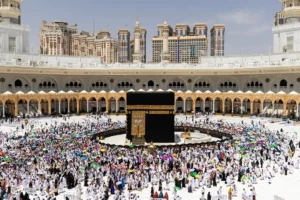
Every year, thousands of pilgrims from the USA and Canada decide in the weeks before Ramadan that this is the year they want to perform Umrah. Many of them discover that the hotels closest to the Haram are already full, flights are expensive, and the dates they wanted are gone.
If you are hoping to spend part of Ramadan 2027 in Makkah or Madinah, the planning window is open right now, and it is narrowing. This blog explains what to expect, what sells out first, and how to build a realistic booking timeline.
When Is Ramadan 2027 Expected to Begin?
Based on astronomical calculations, Ramadan 2027 is expected to begin around 8 February 2027, with the last ten nights falling in late February and early March, and Eid al-Fitr expected around 9 or 10 March 2027.
What to check:
- Treat these dates as estimates. The Hijri calendar depends on moon sighting, so the start of Ramadan may shift by a day in either direction.
- Do not wait for the official announcement to book. Flights and hotels must be secured months earlier, so plan around the expected window with some flexibility.
- Use a reliable Islamic calendar or the Nusuk app to confirm exact dates closer to your travel.
Because the Hijri calendar runs 10 to 11 days shorter than the Gregorian year, Ramadan 2027 arrives about ten days earlier than Ramadan 2026. That is worth remembering if you are comparing prices or experiences with a previous year.
Why Ramadan Books Out Earlier Than Any Other Season
Ramadan is the one period when demand for Umrah is concentrated into roughly thirty days. Pilgrims from every part of the world are aiming for the same hotels and the same flights.
Several factors compound this:
- Spiritual weight. Many pilgrims plan around the narration that Umrah in Ramadan carries a reward equal to Hajj, and they plan well in advance.
- Fixed dates. Unlike an ordinary month, there is no flexibility. You cannot shift Ramadan by a week to find a cheaper fare.
- Limited inventory near the Haram. The hotels within walking distance of Masjid al-Haram and Masjid an-Nabawi are limited in number, and long-standing group bookings take up a large share of them.
- Early commitments. Large groups and returning pilgrims often reserve rooms many months ahead, so by the time individual travelers start searching, availability may already be thin.
For families, especially multi-generational groups from the USA and Canada, this matters even more. Rooms that comfortably fit three or four people are always the first to go.
What Sells Out First
If you are planning for Ramadan, expect these to disappear in roughly this order:
- Hotels in the first and second rows of the Haram. These are the most sought after, particularly for the last ten nights.
- Family and quad rooms. There are fewer of them per hotel, and demand from families is high.
- Direct and convenient flights. Shorter itineraries and well-timed arrivals fill before long layover routes do.
- Hotels near Masjid an-Nabawi for the final days of Ramadan. Pilgrims who want to spend time in Madinah are competing for a smaller pool of rooms.
- Flexible dates. Once the best weeks are gone, you are left choosing from whatever remains.
How Prices Move as Ramadan Approaches
Flights, hotels and Umrah packages are priced dynamically, and the pattern is consistent year after year: the closer you get to Ramadan, the less choice you have, and the more you pay for what is left.
What to expect:
- Early booking gives you the widest selection of hotels, room types and flight options, and often the most reasonable pricing.
- Mid-way booking still works, but with fewer rooms near the Haram and less flexibility on dates.
- Late booking means the highest prices of the year, with limited availability. This is especially true for the last ten nights.
Another point in favor of booking early: with a reputable Umrah Tour Operator, a confirmed package typically gives you a fixed price, which protects you from later increases.
Choosing Your Window: Early, Middle or Last Ten Nights
There is no single correct answer. Each part of Ramadan offers something different.
- First ten days: The crowd is heavy but still more manageable than later in the month. A good option if you want the atmosphere of Ramadan with a bit more breathing room.
- Middle ten days: Often a balanced choice, with steady crowds and the full rhythm of Taraweeh, suhoor and iftar.
- Last ten nights: The most spiritually intense period, and the busiest and most expensive. Pilgrims come specifically to seek Laylatul Qadr, and the Haram is at its fullest.
If you are traveling with elderly parents or young children, you may find the early or middle part of Ramadan far more comfortable than the final ten nights. The closing days bring dense crowds and long waits, so be honest about your family’s physical capacity.
Your Booking Timeline: What to Do and When
Since Ramadan 2027 is expected to start in early February, here is a practical way to work backward from your travel dates.
Now to mid-November (3 to 4 months out)
- Decide your window: early, middle or last ten nights.
- Confirm that all passports are valid for at least six months from your travel date.
- Speak with an Umrah Tour Operator to compare hotel options and secure rooms.
- Place your booking and keep your written confirmation.
Mid-November to December (2 to 3 months out)
- Confirm flights and visa processing.
- Gather documents for each traveler, including minors.
- Ask your doctor about recommended vaccinations and travel health.
January (about 4 to 6 weeks out)
- Install the Nusuk app and complete registration for everyone in your group.
- Book your Rawdah slot in Madinah as early as your dates allow.
- Begin a daily walking routine to build stamina for Tawaf and Sa’i.
Final 1 to 2 weeks
- Reconfirm all bookings, pack, and arrange time off work or school.
- Keep medications in your hand luggage, along with copies of your prescriptions.
If you are reading this later than the timeline suggests, do not assume it is too late. It simply means your options are narrower, so act soon.
Planning the Last Ten Nights Specifically
The last ten nights deserve their own planning because they place the greatest demands on your time, energy and budget.
Aisha (ر) described how the Prophet (ﷺ) approached these nights:
كَانَ النَّبِيُّ صلى الله عليه وسلم إِذَا دَخَلَ الْعَشْرُ شَدَّ مِئْزَرَهُ، وَأَحْيَا لَيْلَهُ، وَأَيْقَظَ أَهْلَهُ
Narrated by Hz. Aisha (ر): “When the last ten nights began, the Prophet (ﷺ) would tighten his waist wrapper, spend the night in worship, and wake his family.”
Sahih al-Bukhari, No. 2024
What to check:
- Decide whether you want to spend all ten nights in the Haram or only part of that period, since the physical toll is considerable.
- Choose accommodation as close to the Haram as your budget allows, because long walks late at night, after suhoor or after Taraweeh, add up quickly.
- Plan your rest. Many pilgrims sleep in short blocks during the day so they have energy for night worship.
- Agree on a meeting point with your family before each prayer, since the crowds can separate groups easily.
- Keep your schedule flexible. Your worship matters more than a perfectly filled itinerary.
Practical Tips for Pilgrims from the USA and Canada
- Account for the time difference. Build in at least a day or two to rest after arrival before beginning your rituals.
- Travel health. Cold and flu season overlaps with this window, so carry hand sanitizer and consider a mask in crowded areas.
- Fasting and travel. If you are fasting while traveling, plan hydration and meals carefully on the days you travel, and ask a scholar about your specific situation.
- Work and school. Submit leave requests early and request written documentation for any missed school days.
- Budget buffer. Keep a small reserve for personal expenses, since Ramadan prices around the Haram are higher than usual.
Common Mistakes to Avoid
- Waiting for the moon-sighting announcement before booking anything.
- Booking flights first and hotels later, only to find nothing close to the Haram.
- Choosing the last ten nights without considering the physical demands on elderly relatives or young children.
- Skipping Nusuk registration until after arrival.
- Overpacking the itinerary and leaving no time for rest.
- Treating a cheaper, further hotel as a minor detail when it may mean a long walk every day.
Quick Reference
- Ramadan 2027 is expected to begin around 8 February 2027, subject to moon sighting.
- Book early. Ramadan inventory near the Haram sells out first, especially family rooms.
- Prices rise and choices shrink as the date approaches.
- Pick your window honestly: early, middle or last ten nights.
- Start documents, visas and Nusuk registration well ahead.
- Plan accommodation, rest and meeting points for the last ten nights.
- Ask your Umrah Tour Operator for written confirmation of every inclusion.
Final Word
Planning early is not a sign of anxiety. It is part of preparing responsibly for a journey you have intended for a long time. The Prophet (ﷺ) taught the balance between effort and reliance on Allah:
اعْقِلْهَا وَتَوَكَّلْ
Narrated by Hz. Anas ibn Malik (ر): A man asked, “Should I tie my camel and trust in Allah, or leave it untied and trust in Allah?” The Prophet (ﷺ) said, “Tie it and trust in Allah.”
Jami at-Tirmidhi, No. 2517
Making your arrangements early is the tying of the camel. The acceptance, the ease and the outcome are with Allah (ﷻ).
May Allah (ﷻ) grant you the opportunity to witness Ramadan in His blessed house, make every step of your planning easy, and accept the Umrah you offer with a sincere and humble heart. Ameen.
Ready to Begin Your Umrah Journey?
Umrah Lane Inc.
📍 57 North Street, Suite #401, Danbury, CT 06810, USA
🟢 WhatsApp: +1 (475) 237-9600
📞 +1 (203) 401-8765
📧 info@umrahlane.com
🌐 www.umrahlane.com