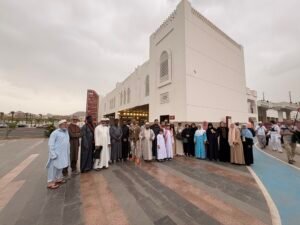
Umrah is not only a set of physical rituals. From the moment the intention is made until the pilgrim returns home, it is a journey carried by dua. Every step of Umrah has a moment where the Prophet Muhammad (ﷺ) taught his companions to turn to Allah (ﷻ) in supplication.
For many first-time pilgrims, one of the most common concerns is not knowing what to say at each stage of the journey. This guide brings together the essential duas for Umrah, in Arabic, transliteration and English meaning, so that you can recite them with understanding and sincerity rather than simply repeating unfamiliar sounds.
A note before you begin: while the duas below are recommended and rooted in the Sunnah, Umrah does not require memorization of every word. Many pilgrims carry a small dua booklet or use a mobile app during their rituals, and this is entirely acceptable. What matters most is presence of heart, not perfection of recitation.
1. The Talbiyah
The Talbiyah is the first and most repeated supplication of Umrah. It begins the moment you enter the state of Ihram at the Miqat and continues, ideally in a raised voice for men, until you begin Tawaf.
لَبَّيْكَ اللَّهُمَّ لَبَّيْكَ، لَبَّيْكَ لَا شَرِيكَ لَكَ لَبَّيْكَ، إِنَّ الْحَمْدَ وَالنِّعْمَةَ لَكَ وَالْمُلْكَ، لَا شَرِيكَ لَكَ
Labbayk Allahumma labbayk, labbayka la shareeka laka labbayk, inna al-hamda wan-ni’mata laka wal-mulk, la shareeka lak.
Meaning: Here I am, O Allah, here I am. Here I am, You have no partner, here I am. Verily all praise, grace and sovereignty belong to You. You have no partner.
Sahih al-Bukhari, No. 1549 & Sahih Muslim, No. 1184
2. Dua of Intention (Niyyah) for Umrah
Before entering Ihram, the pilgrim states the intention to perform Umrah. This can be said silently in the heart, but many scholars recommend voicing it as well.
اللَّهُمَّ إِنِّي أُرِيدُ الْعُمْرَةَ فَيَسِّرْهَا لِي وَتَقَبَّلْهَا مِنِّي
Allahumma inni ureedul-‘umrata fa yassirha li wa taqabbalha minni.
Meaning: O Allah, I intend to perform Umrah, so make it easy for me and accept it from me.
A commonly used formulation reflecting the intention (niyyah) taught by the scholars; the core requirement is the sincere intention in the heart.
3. Dua for Entering Masjid al-Haram
Upon reaching the boundary of Masjid al-Haram, it is Sunnah to enter with the right foot and recite the general dua for entering any mosque.
اللَّهُمَّ افْتَحْ لِي أَبْوَابَ رَحْمَتِكَ
Allahumma iftah li abwaba rahmatik.
Meaning: O Allah, open for me the doors of Your mercy.
Sahih Muslim, No. 713
4. Dua Upon First Seeing the Kaaba
There is a well-known moment for every pilgrim: the first sight of the Kaaba after entering the mosque. Many scholars note that this is a time when dua is accepted, so pilgrims are encouraged to pause and ask Allah (ﷻ) for whatever is on their heart, in addition to reciting the following.
اللَّهُمَّ زِدْ هَذَا الْبَيْتَ تَشْرِيفًا وَتَعْظِيمًا وَتَكْرِيمًا وَمَهَابَةً، وَزِدْ مَنْ شَرَّفَهُ وَكَرَّمَهُ مِمَّنْ حَجَّهُ أَوِ اعْتَمَرَهُ تَشْرِيفًا وَتَكْرِيمًا وَتَعْظِيمًا وَبِرًّا
Allahumma zid hadhal-bayta tashrifan wa ta’zeeman wa takreeman wa mahabah, wa zid man sharrafahu wa karramahu mimman hajjahu awi’tamarahu tashrifan wa takreeman wa ta’zeeman wa birra.
Meaning: O Allah, increase this House in honor, esteem, respect and reverence, and increase those who honor and venerate it – those who perform Hajj or Umrah – in honor, esteem, respect and righteousness.
Reported from the practice of the Salaf; cited by Imam al-Shafi’i and later scholars of fiqh.
5. Dua During Tawaf
There is no single obligatory dua for the seven circuits of Tawaf, and pilgrims are free to recite Quran, dhikr or personal supplications throughout. However, one dua is specifically confirmed from the Sunnah, to be recited between the Yemeni Corner (Rukn al-Yamani) and the Black Stone (Hajar al-Aswad) in each circuit.
رَبَّنَا آتِنَا فِي الدُّنْيَا حَسَنَةً وَفِي الْآخِرَةِ حَسَنَةً وَقِنَا عَذَابَ النَّارِ
Rabbana atina fid-dunya hasanatan wa fil-akhirati hasanatan wa qina ‘adhaban-nar.
Meaning: Our Lord, give us good in this world and good in the Hereafter, and protect us from the punishment of the Fire.
Surah al-Baqarah, 2:201; also reported in Sunan Abu Dawood, No. 1892
6. Dua at the Multazam
The Multazam is the section of wall between the Black Stone and the door of the Kaaba. After completing Tawaf, if it is possible to reach it without causing harm or crowding to others, it is recommended to place the chest, face and hands against it and supplicate. There is no fixed wording for this moment – pilgrims are encouraged to pour out their personal duas here, in whatever language they are most comfortable in.
7. Dua After the Two Rak’ahs at Maqam Ibrahim
After Tawaf, it is Sunnah to pray two short rak’ahs behind or near Maqam Ibrahim, reciting Surah al-Kafirun in the first rak’ah and Surah al-Ikhlas in the second. Afterward, it is recommended to ask Allah (ﷻ) sincerely for the acceptance of the Tawaf just completed.
اللَّهُمَّ تَقَبَّلْ مِنِّي
Allahumma taqabbal minni.
Meaning: O Allah, accept this from me.
A concise supplication reflecting the broader Quranic dua of Ibrahim (عليه السلام) in Surah al-Baqarah, 2:127.
8. Dua for Drinking Zamzam Water
Zamzam holds a special status: it is reported that the water takes on the purpose for which it is drunk. Before drinking, it is recommended to face the Qiblah, say Bismillah, and make dua.
اللَّهُمَّ إِنِّي أَسْأَلُكَ عِلْمًا نَافِعًا، وَرِزْقًا وَاسِعًا، وَشِفَاءً مِنْ كُلِّ دَاءٍ
Allahumma inni as’aluka ‘ilman nafi’an, wa rizqan wasi’an, wa shifa’an min kulli da’.
Meaning: O Allah, I ask You for beneficial knowledge, abundant provision, and healing from every ailment.
Reflects the hadith principle reported in Sunan Ibn Majah, No. 3062, regarding the purpose-driven nature of Zamzam water.
9. Dua Between Safa and Marwah
As Sa’i begins, the pilgrim ascends Safa, faces the Kaaba, and recites the following before walking toward Marwah. This is repeated at the start of each of the seven circuits.
لَا إِلَهَ إِلَّا اللَّهُ وَحْدَهُ لَا شَرِيكَ لَهُ، لَهُ الْمُلْكُ وَلَهُ الْحَمْدُ، يُحْيِي وَيُمِيتُ وَهُوَ عَلَى كُلِّ شَيْءٍ قَدِيرٌ
La ilaha illallahu wahdahu la shareeka lah, lahul-mulku wa lahul-hamd, yuhyi wa yumeetu wa huwa ‘ala kulli shay’in qadeer.
Meaning: There is no god but Allah alone, He has no partner. His is the dominion and His is all praise. He gives life and causes death, and He has power over all things.
Sahih Muslim, No. 1218, from the detailed hadith describing the Farewell Hajj of the Prophet (ﷺ)
10. Dua After Completing Umrah
Once Halq or Taqsir is completed and Ihram is exited, Umrah is complete. There is no obligatory closing dua, but it is a beautiful practice to end the journey the way it began – in gratitude and hope for acceptance.
اللَّهُمَّ تَقَبَّلْ مِنَّا إِنَّكَ أَنْتَ السَّمِيعُ الْعَلِيمُ
Allahumma taqabbal minna innaka antas-sami’ul-‘aleem.
Meaning: O Allah, accept this from us. Indeed, You are the All-Hearing, the All-Knowing.
Reflects the dua of Ibrahim and Isma’il (عليهما السلام) upon building the Kaaba, Surah al-Baqarah, 2:127
Quick Reference: Essential Duas at a Glance
- Talbiyah – recited from Ihram until Tawaf begins
- Niyyah – the intention made before entering Ihram
- Entering Masjid al-Haram – asking Allah to open the doors of His mercy
- Seeing the Kaaba – a moment when dua is especially encouraged
- Tawaf – Rabbana atina between the Yemeni Corner and the Black Stone
- Multazam – personal, unscripted dua after Tawaf
- Maqam Ibrahim – two rak’ahs, followed by a dua for acceptance
- Zamzam – dua for knowledge, provision and healing before drinking
- Safa and Marwah – the tahleel recited at the start of each round of Sa’i
- After Umrah – a closing dua asking Allah to accept the journey
A Final Reminder
The duas above are a guide, not a checklist to rush through. If you forget the exact wording in the moment, speak to Allah (ﷻ) in your own words and your own language – He knows what is in every heart before it is spoken. Many pilgrims find it helpful to carry a printed dua card or a phone app with these supplications so they are not searching for words while standing in front of the Kaaba.
May Allah (ﷻ) accept every step of your Umrah, place sincerity in your heart at every station of the journey, and grant you the honor of returning to His House again and again. Ameen.
Ready to Begin Your Umrah Journey?
Umrah Lane Inc.
📍 57 North Street, Suite #401, Danbury, CT 06810, USA
🟢 WhatsApp: +1 (475) 237-9600
📞 +1 (203) 401-8765
📧 info@umrahlane.com