Hajj and Umrah are two distinct acts of worship with different levels of obligation, different rituals, different timing and different spiritual significance. Understanding the difference is not merely an academic exercise. For a Muslim who intends to travel to the holy cities, knowing exactly what you are undertaking is part of the preparation itself.
What Is Umrah?
Umrah is a voluntary Islamic pilgrimage to Makkah. It is referred to as the lesser pilgrimage and can be performed at almost any time of the year, outside of the days of Hajj in Dhul Hijjah.
Umrah consists of four core rituals performed in sequence:
- Entering the state of Ihram at the designated Miqat boundary
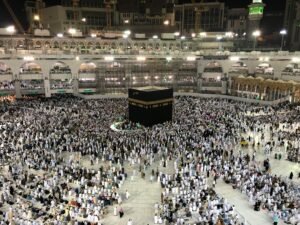
- Performing Tawaf circumambulating the Kaaba seven times in a counter-clockwise direction
- Performing Sa’i walking between the hills of Safa and Marwah seven times
- Completing Halq or Taqsir shaving or trimming the hair to exit the state of Ihram
These four steps mark the beginning and end of Umrah. The entire process can be completed within a few hours, depending on crowd conditions inside Masjid al-Haram.
While Umrah is not obligatory, the Prophet Muhammad (ﷺ) performed it multiple times and described it as holding tremendous spiritual merit.
عَنْ أَبِي هُرَيْرَةَ رَضِيَ اللَّهُ عَنْهُ أَنَّ رَسُولَ اللَّهِ صَلَّى اللَّهُ عَلَيْهِ وَسَلَّمَ قَالَ: الْعُمْرَةُ إِلَى الْعُمْرَةِ كَفَّارَةٌ لِمَا بَيْنَهُمَا
Narrated by Hz. Abu Hurairah (ر): Allah’s Messenger (ﷺ) said: “From one Umrah to the next is an expiation for whatever comes in between them.”
Sahih al-Bukhari, No. 1773 & Sahih Muslim, No. 1349
What Is Hajj?
Hajj is the fifth and final pillar of Islam. It is an obligation upon every Muslim who is physically and financially capable of performing it, at least once in their lifetime.
Allah (ﷻ) commands it explicitly in the Quran:
وَلِلَّهِ عَلَى النَّاسِ حِجُّ الْبَيْتِ مَنِ اسْتَطَاعَ إِلَيْهِ سَبِيلًا
“And [due] to Allah from the people is a pilgrimage to the House – for whoever is able to find thereto a way.”
Surah Aal Imran, 3:97
Hajj takes place during the first ten days of Dhul Hijjah, the twelfth and final month of the Islamic calendar. It is one of the largest annual gatherings of people on earth, with millions of pilgrims converging on Makkah from every corner of the world.
Hajj involves all the rituals of Umrah plus several additional, obligatory steps:
- Wuquf at Arafat – (9th Dhul Hijjah) – standing at the plain of Arafat in supplication. This is the single most important pillar of Hajj. The Prophet (ﷺ) said: “Hajj is Arafat.” [Sunan Abu Dawood, No. 1949]
- Spending the night at Muzdalifah collecting pebbles for the Rami
- Rami al-Jamarat – stoning the three pillars at Mina, symbolizing the rejection of Shaytan
- Qurbani – sacrificing an animal (obligatory for Hajj al-Tamattu and Hajj al-Qiran)
- Halq or Taqsir – shaving or trimming the hair
- Tawaf al-Ifadah – the obligatory Tawaf after Arafat
- Sa’i – walking between Safa and Marwah
- Tawaf al-Wada – the farewell Tawaf before leaving Makkah
The full Hajj spans five to six days and involves spending nights in Mina and Muzdalifah, outdoor rituals in open plains and considerable physical endurance.
The Key Differences Explained
1. Obligation
Hajj is Fard obligatory for every Muslim who meets the conditions of ability (istita’ah): physical health, financial means and safety of travel. Failing to perform it without a valid excuse is a major sin.
Umrah is classified as Sunnah Mu’akkadah (a highly emphasized sunnah) by the majority of scholars. It carries immense reward but does not carry the same level of obligation as Hajj.
2. Timing
Umrah can be performed at any point during the year, with one exception: it is generally advised not to perform Umrah during the days of Hajj itself (8th–13th Dhul Hijjah) as the Haram is at peak capacity and the conditions change significantly.
Hajj is only performed once a year during a fixed window in the Islamic calendar the first ten days of Dhul Hijjah, with the critical day of Arafat falling on the 9th. If a pilgrim misses the standing at Arafat, the entire Hajj is void for that year.
3. Rituals
Umrah has four core rituals. Hajj includes all of those and adds several more, including the obligatory Wuquf at Arafat, stoning at Mina, the night at Muzdalifah and the animal sacrifice.
Think of it this way: every Hajj contains within it the essence of Umrah, but Umrah alone does not constitute Hajj.
4. Duration
Umrah, depending on the crowd, can be completed in as little as two to three hours or may take a full day. A pilgrim may perform multiple Umrahs during a single trip to Makkah.
Hajj, by contrast, spans a minimum of five to six days and cannot be condensed. Specific rituals must be performed on specific days and at specific locations. There is no shortcut.
5. Physical and Financial Demand
Umrah is accessible to a wide range of pilgrims in terms of cost and physical effort. A family with young children or elderly members can perform Umrah with proper planning and support.
Hajj is one of the most physically and logistically demanding acts of worship in Islam. The outdoor rituals at Arafat, Muzdalifah and Mina require endurance, particularly during the summer months when heat can be extreme. The costs are also significantly higher due to the extended trip, camp accommodations and the obligatory Qurbani.
The Three Types of Hajj
One aspect that often causes confusion is that Hajj itself has three forms. Understanding these is important because one of them directly involves performing Umrah as part of Hajj.
Hajj al-Tamattu (The Most Common Form)
The pilgrim performs Umrah first (entering Ihram, Tawaf, Sa’i and Halq/Taqsir) and exits the state of Ihram. They then re-enter Ihram on the 8th of Dhul Hijjah specifically for Hajj. This is the method most recommended for pilgrims travelling from outside the Arabian Peninsula and is the form advised by the Prophet (ﷺ) for his companions.
A Qurbani (sacrifice) is obligatory in this form.
Hajj al-Qiran (Combined)
The pilgrim enters Ihram for both Umrah and Hajj simultaneously and does not exit the state of Ihram between the two. The rituals of Umrah and Hajj are performed together, with one Tawaf and one Sa’i serving both.
A Qurbani is also obligatory in this form.
Hajj al-Ifrad (Hajj Only)
The pilgrim enters Ihram solely for Hajj without performing Umrah during that trip. No Qurbani is obligatory in this form, though it remains recommended.
The key takeaway: in Hajj al-Tamattu and Hajj al-Qiran, Umrah is performed as part of the Hajj journey. But this Umrah does not substitute for a standalone Umrah performed at any other time of the year.
Can Umrah Replace Hajj?
No. Umrah, no matter how many times it is performed, does not fulfill the obligation of Hajj. They are two separate acts of worship.
A Muslim who is financially and physically capable of Hajj is obligated to perform it and cannot substitute repeated Umrah visits in its place. The two co-exist: many pilgrims perform Umrah multiple times throughout their lives and still have the obligation of Hajj if they meet the conditions.
However, performing Umrah before Hajj is deeply encouraged. It familiarizes the pilgrim with the rituals, the geography of Masjid al-Haram, the physical demands and the spiritual experience. Many scholars and experienced pilgrims recommend performing Umrah at least once before undertaking Hajj, particularly for first-time pilgrims.
The Spiritual Difference
Both Hajj and Umrah are journeys of the heart, not merely the body. Both involve detaching from the world, entering a state of consecrated purity and standing before Allah (ﷻ) in complete submission. The outward rituals are vehicles for an inward transformation.
However, the spiritual magnitude of Hajj is in a category of its own. The Prophet (ﷺ) described its reward in the clearest possible terms:
مَنْ حَجَّ لِلَّهِ فَلَمْ يَرْفُثْ وَلَمْ يَفْسُقْ رَجَعَ كَيَوْمِ وَلَدَتْهُ أُمُّهُ
Narrated by Hz. Abu Hurairah (ر): The Prophet (ﷺ) said: “Whoever performs Hajj for the sake of Allah and does not engage in obscene speech or sinful conduct will return as pure as the day his mother bore him.”
Sahih al-Bukhari, No. 1521
The Day of Arafat, the central pillar of Hajj, is considered the greatest day in the Islamic calendar. Standing at Arafat is described in the traditions of the Prophet (ﷺ) as a moment of mass divine mercy, forgiveness and acceptance of supplication. It is a convergence of the entire Muslim Ummah in one place, all dressed alike, all supplicating to the same One God.
This scale of collective worship, combined with the specific rituals of Hajj, is why it holds a status in Islam that no other act of worship, including Umrah, can match.
Which Should You Do First?
This is one of the most frequently asked questions by Muslims who are planning their first trip to the holy cities. The honest answer is: perform Umrah first if you are able.
Here is why:
• Umrah is accessible year-round and can be planned more flexibly in terms of timing, budget and duration
• The rituals of Umrah form the foundation of the Hajj rituals. Performing Umrah first builds familiarity and confidence
• The spiritual experience of Umrah often deepens the yearning for Hajj, strengthening the intention and preparation
• For those with elderly family members who may not be able to wait years for Hajj, Umrah ensures they are able to perform an act of pilgrimage while they are still able
That said, if you are in a position to perform Hajj and the opportunity presents itself, do not delay it. The Prophet (ﷺ) urged Muslims not to postpone Hajj once the conditions are met:
تَعَجَّلُوا إِلَى الْحَجِّ، فَإِنَّ أَحَدَكُمْ لَا يَدْرِي مَا يَعْرِضُ لَهُ
“Hasten to perform Hajj, for none of you knows what may befall him.”
Musnad Ahmad, No. 2867
The Role of a Reliable Umrah Tour Operator
Whether you are planning Umrah or preparing for Hajj, the logistical complexity of the journey to the holy cities demands careful preparation. For Hajj in particular, the requirements around documentation, Hajj permits, camp bookings in Mina, the timing of rituals and the sheer number of pilgrims present make the guidance of an experienced operator not just convenient, but genuinely important.
An experienced Umrah Tour Operator will:
• Handle all visa and documentation requirements on your behalf
• Secure hotel accommodation in proximity to Masjid al-Haram
• Provide knowledgeable religious guidance throughout the rituals
• Manage all ground transportation, intercity travel and airport transfers
• Offer pre-trip preparation through orientation sessions and webinars
• Ensure you are fully prepared on both a logistical and spiritual level before you step foot in the Haram
For first-time pilgrims, families, the elderly or anyone approaching these sacred rituals without prior experience, having dedicated support allows you to remain focused on what truly matters: your worship, your duas and your relationship with Allah (ﷻ).
Final Word
Hajj and Umrah are both journeys toward Allah (ﷻ). Both are expressions of love, submission and longing. But they are not the same, and knowing the difference allows you to approach each one with the understanding, preparation and reverence it deserves.
If you have not yet performed Umrah, let it be the first step. If you have performed Umrah, let it deepen your longing for Hajj. And if you have been blessed to perform Hajj, know that the duas, the tears and the moments of Wuquf at Arafat remain among the most profound experiences a human being can have in this life.
May Allah (ﷻ) invite you to His house, grant you ease in every step of your journey and accept your worship. Ameen.
Need Help Planning Your Umrah or Hajj?
If you have questions about planning your Umrah or preparing for Hajj, Umrah Lane is at your service. It would be an honor to serve the guests of Allah (ﷻ) and His Prophet Muhammad (ﷺ).
Ready to Begin Your Umrah Journey?
Umrah Lane Inc.
📍 57 North Street, Suite #401, Danbury, CT 06810, USA
🟢 WhatsApp: +1 (475) 237-9600
📞 +1 (203) 401-8765
📧 info@umrahlane.com
🌐 www.umrahlane.com